

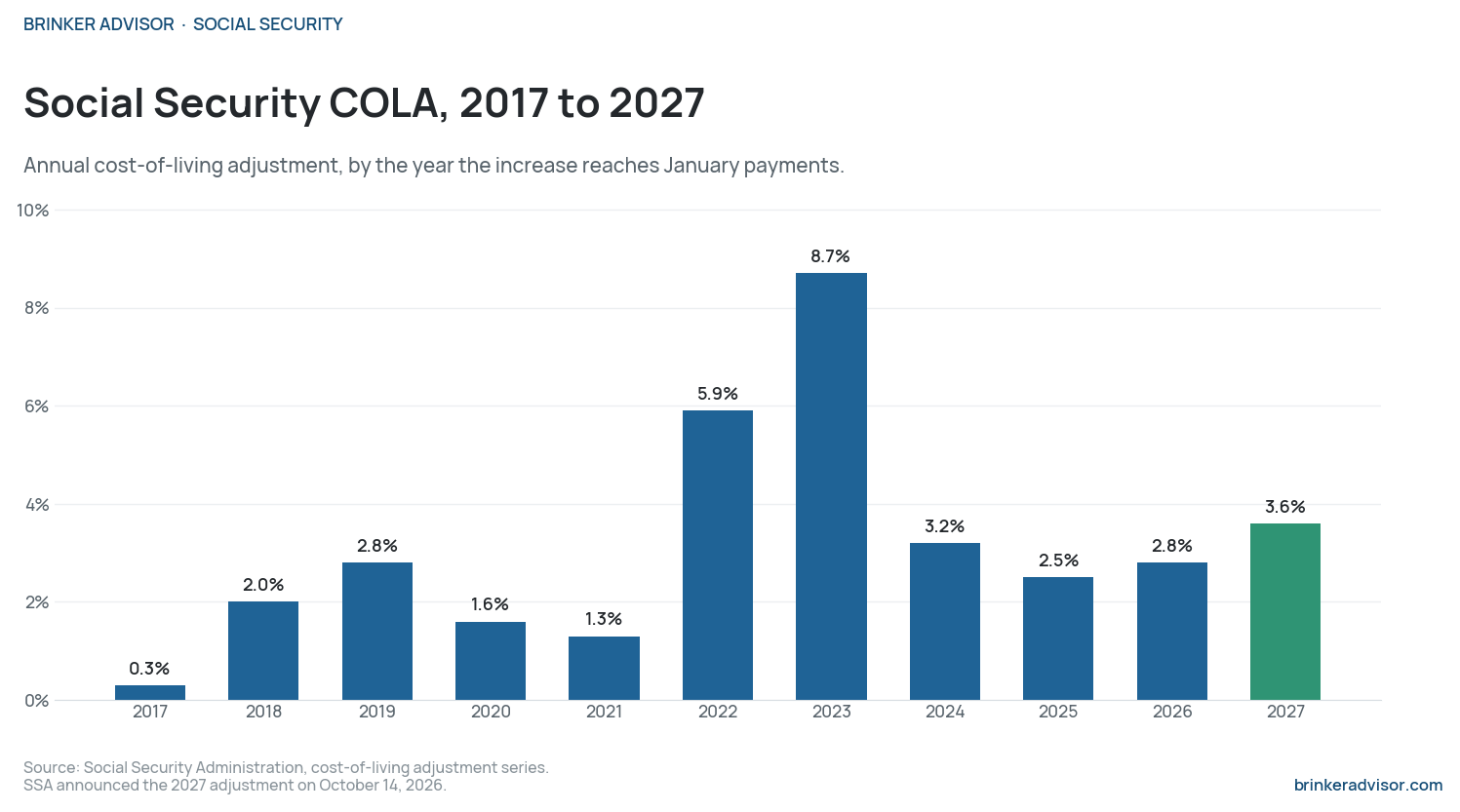
On October 14, the Social Security Administration (SSA) announced that Social Security and Supplemental Security Income (SSI) benefits will increase by 3.6% in 2027, up from 2.8% in 2026 and the largest increase since 2023. The adjustment applies to benefits for December 2026, which are paid in January 2027, while higher SSI payments begin December 31, 2026.
SSA estimates that the average monthly retirement benefit will increase by about $75, from $2,095 to $2,170, in January 2027.
For beneficiaries below full retirement age throughout 2027, the annual earnings limit rises to $25,560 from $24,480. In the year full retirement age is reached, the limit rises to $67,920 from $65,160, counting only earnings before that month. As a reminder, SSA withholds $1 for every $2 above the first limit or $1 for every $3 above the higher limit. Full retirement age is 67 for anyone born in 1960 or later. For this group, claiming at 62 reduces the full monthly benefit by 30%.
The maximum monthly benefit for a worker retiring at full retirement age in 2027 is $4,188. The 2027 Medicare Part B premium, which is deducted from most benefit checks, is usually announced in November.
Most beneficiaries can see their own 2027 amount in the COLA notice posted to my Social Security starting in late November, with paper notices arriving in December. The 2027 Payments Calendar shows the payment dates for each group of beneficiaries, including SSI recipients and those paid on the third of the month.
When Should You Claim?
As stated above, the unreduced monthly retirement benefit is available at full retirement age (FRA), which is 67 for anyone born in 1960 or later. Individuals are also offered both an early claim and a claim deferral option, which will affect the monthly Social Security retirement benefit they receive.
Early claimants can claim benefits starting at age 62. However, claiming at 62 comes with a catch, as the full benefit amount is reduced by 30%. The reduction is smaller if the initial claim starts later; it does not shrink simply because an early claimant gets older. Those who elect to defer their claim until age 70 receive increased payments equal to 124% of the FRA payment. We have included a full illustration of the monthly benefit payments received at each eligible age below.
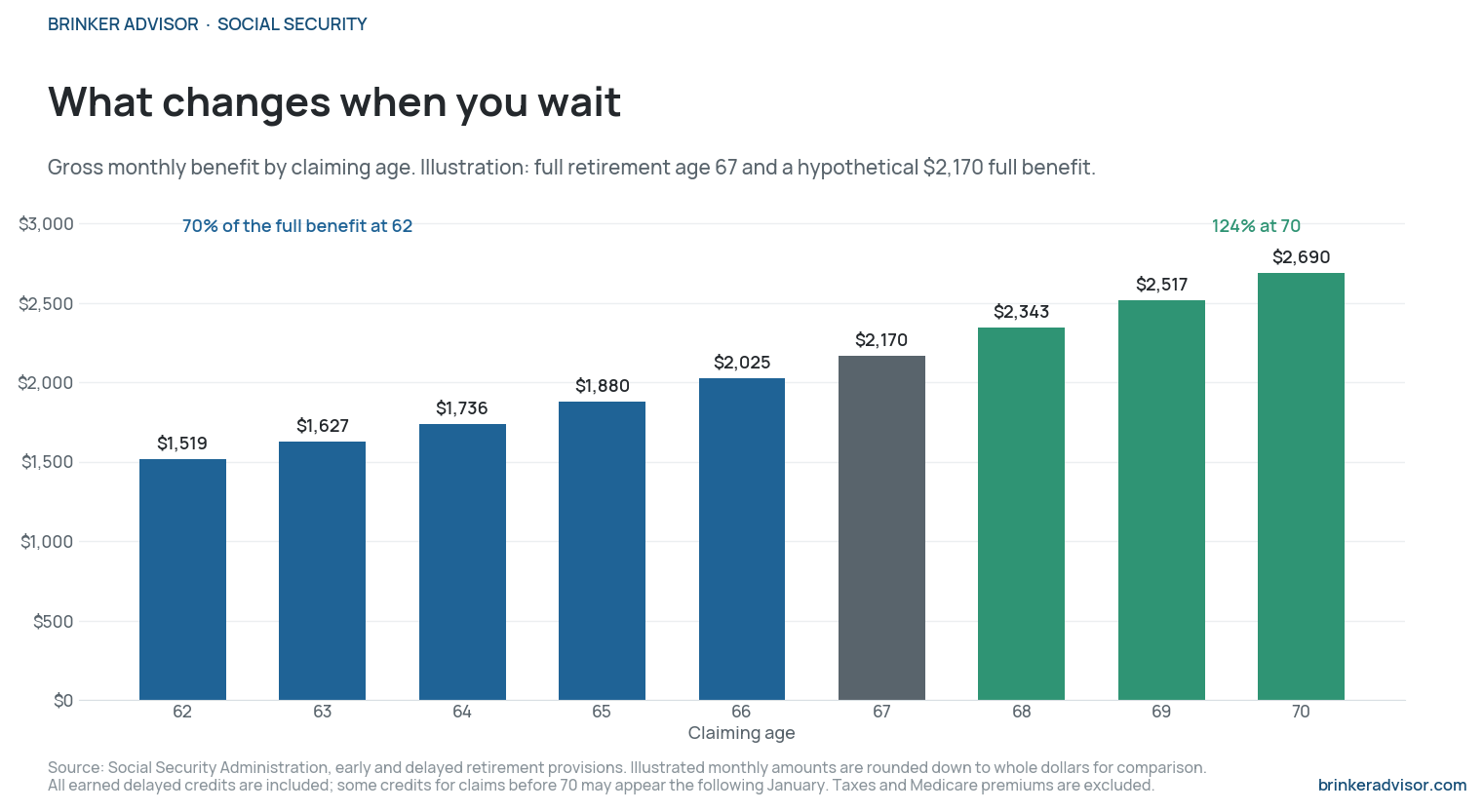
For these illustrations, we assume a $2,170 full retirement age benefit. Actual benefits depend on the earnings record and claiming age. Use your own SSA estimate when comparing the choices.
We would consider three questions before choosing a filing date.
What is my target annual income through retirement, and do I need income today to retire?
How do my health and life expectancy affect this decision?
What would I like to leave to my surviving spouse or other family members?
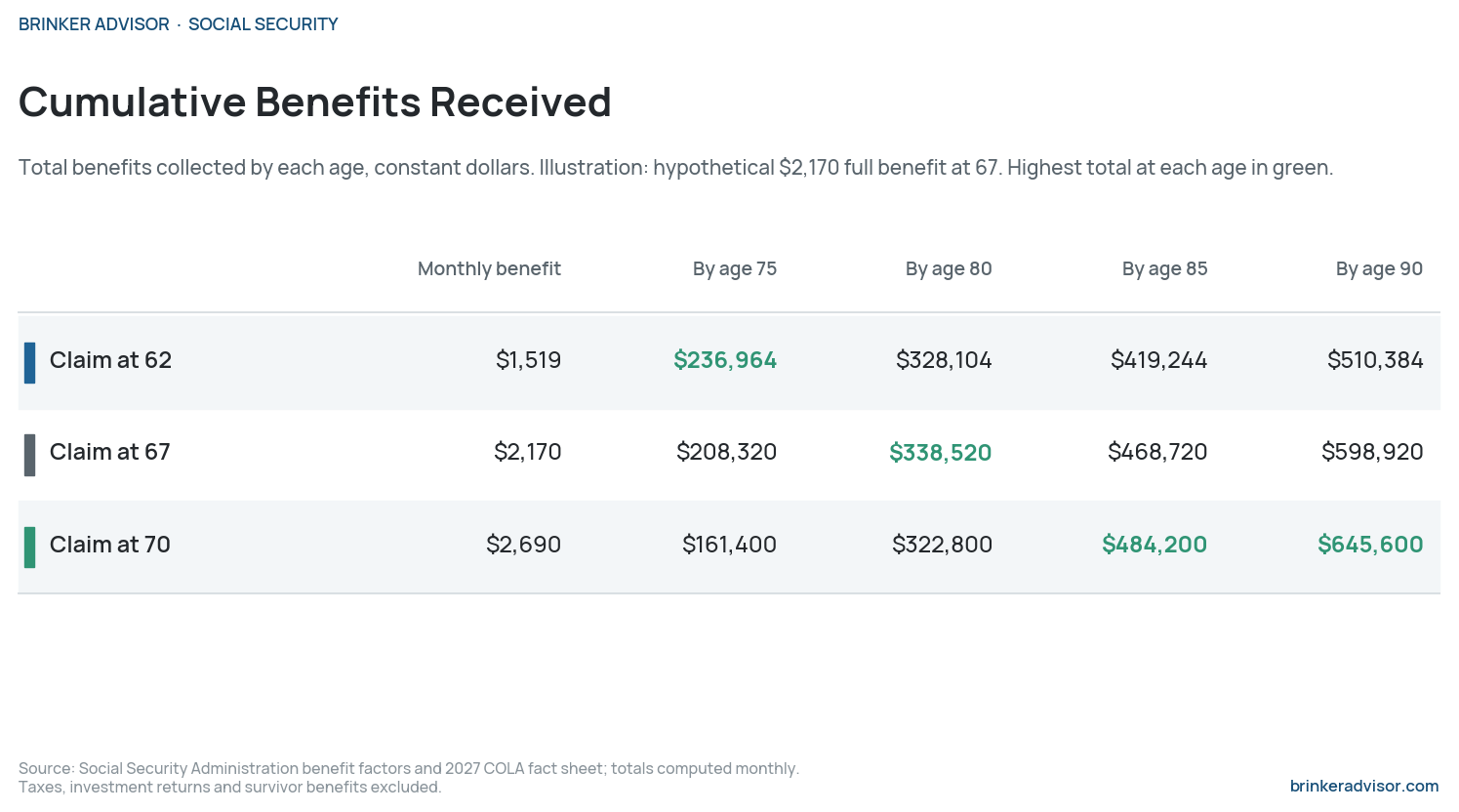
The age-62 claim produces the highest cumulative total by age 75. The full-retirement-age claim leads at 80, while the age-70 claim leads at 85 and 90. These comparisons exclude taxes, investment returns, and survivor benefits.
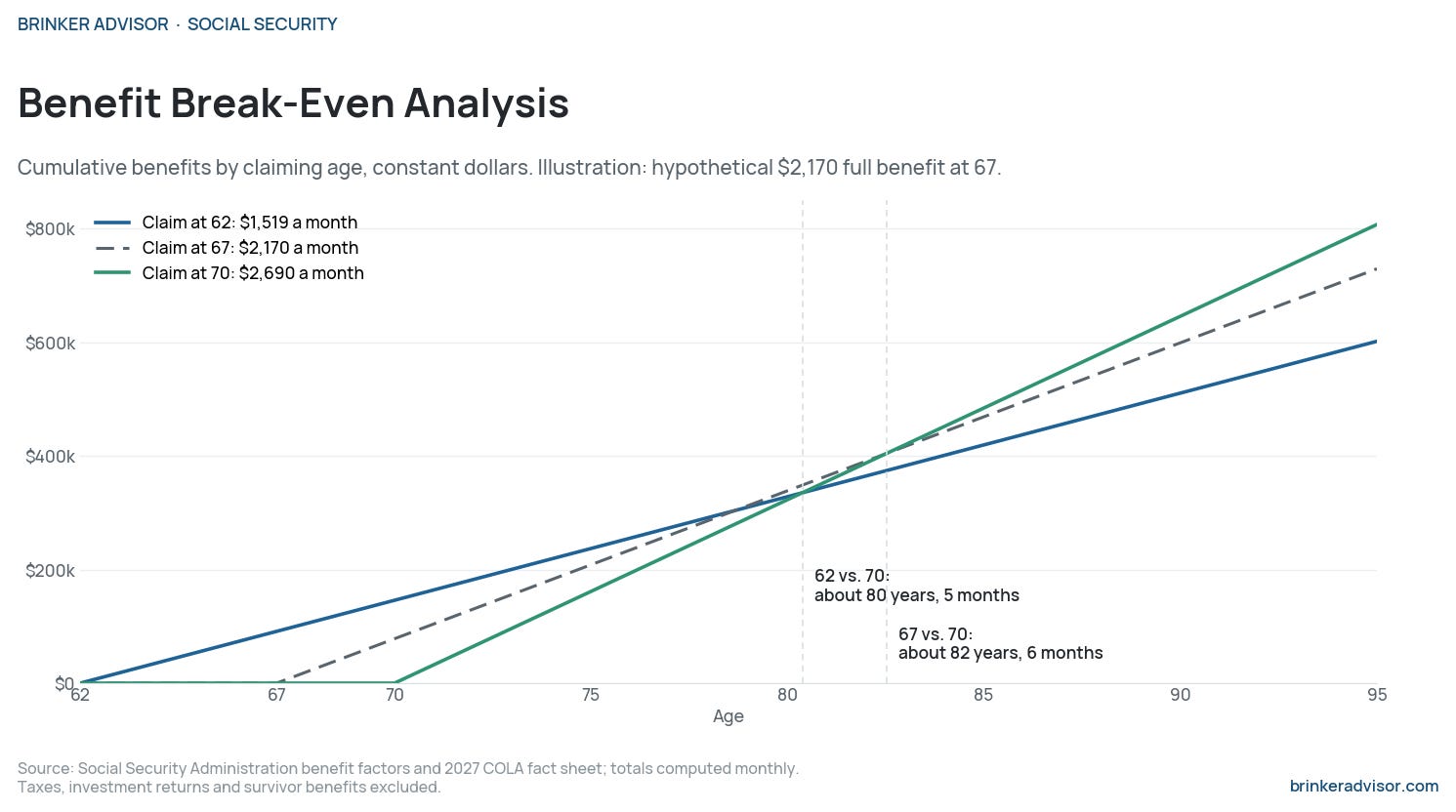
Using the illustrated monthly amounts, the age-70 claim catches the age-62 claim at approximately 80 years, 5 months, and the full-retirement-age claim at approximately 82 years, 6 months. Break-even measures cumulative payments. We would also consider the income needed later in retirement and the amount available to a surviving spouse.
The Survivor’s Check
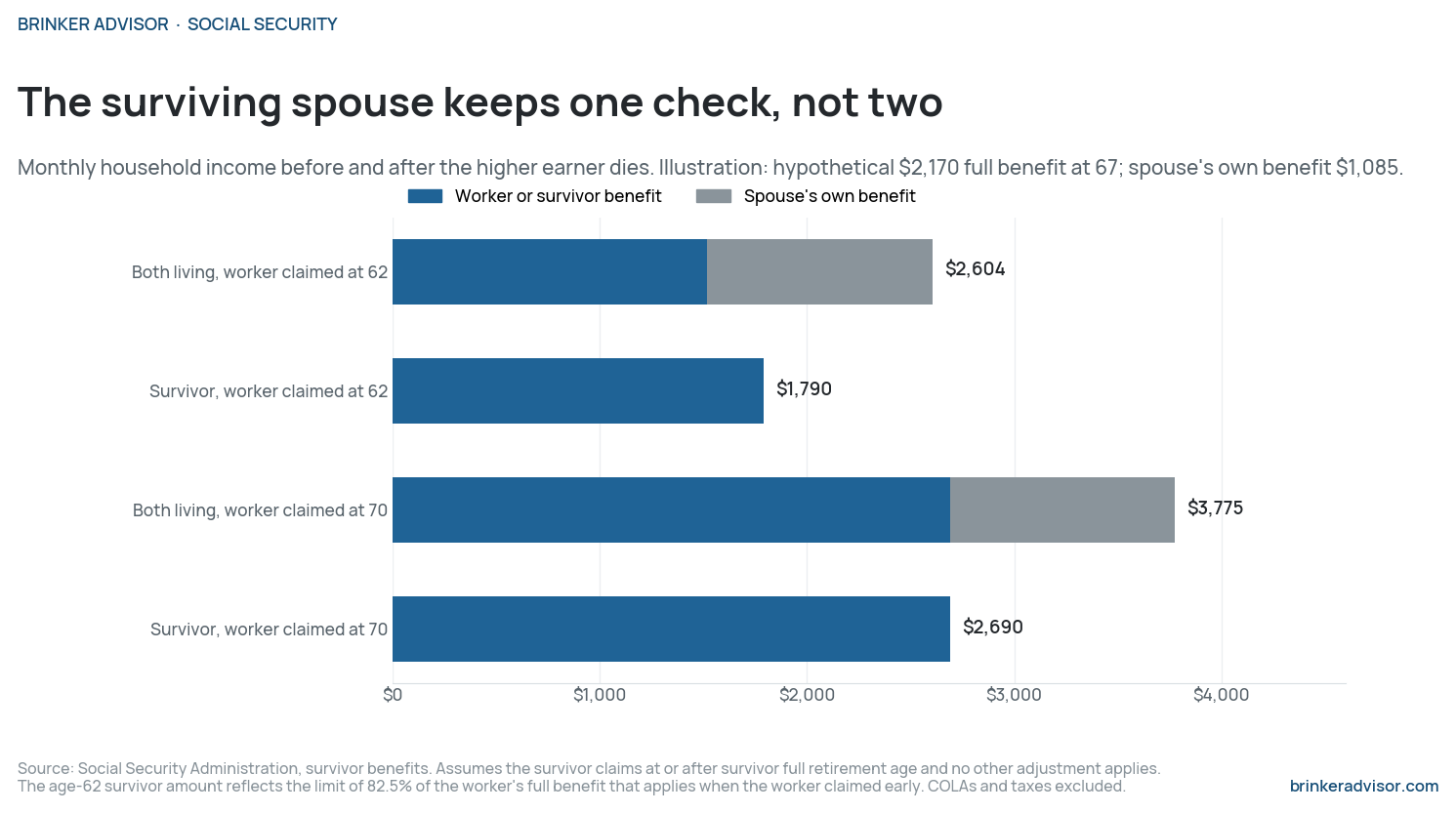
Two full Social Security retirement benefits generally do not continue after the first death. The survivor’s total depends on the applicable retirement and survivor benefits, including the worker’s claiming date and the survivor’s age. The deceased worker’s delayed credits can increase that amount.
Below, we illustrate what the lower-earning spouse’s income may look like following the passing of the higher-earning spouse. The illustration assumes the survivor is at or above survivor full retirement age and the worker earned the illustrated credits. Claiming survivor benefits earlier can reduce the amount.
It is important to have a contingency plan for your spouse’s passing and to ensure you can maintain your lifestyle for the remainder of your retirement.
With a hypothetical $2,170 full retirement age benefit and a spouse receiving $1,085 on their own record, the household receives $2,604 a month while both are living if the worker claimed at 62, and the survivor is left with $1,790, reflecting the limit of 82.5% of the worker’s full benefit that applies when the worker claimed early. If the worker waited until 70, the household receives $3,775 while both are living, and the survivor keeps $2,690. That is about $900 more a month for the survivor, before future COLAs and subject to the assumptions above.
Subscribers can visit our Rates Update page, which updates daily, to view attractive money market funds, certificates of deposit, U.S. Treasury securities, and municipal bond offerings. For broader inflation and economic data, visit our Economic Dashboard. Social Security’s COLA uses CPI-W.
This post is educational information, not personalized tax or financial advice. Figures are from the Social Security Administration, the Bureau of Labor Statistics, and the Centers for Medicare & Medicaid Services as of October 14, 2026. The claiming illustrations assume full retirement age 67, a hypothetical $2,170 full benefit, and no additional earnings. Monthly amounts are rounded down to whole dollars for comparison. Cumulative totals hold purchasing power constant, assuming future COLAs offset inflation, and exclude taxes, investment returns, Medicare premiums, and future changes in law. Survivor assumptions are stated with that illustration.